1972 Nixon VS. McGovern
"Youth"
Transcript
The Living Room Candidate
"Youth," Nixon, 1972
MALE NARRATOR: You asked for an end to the war. You wanted peace. You said the draft was unfair. Why should blacks and poor kids be more liable to the draft than the whites and well-off. You asked for a say in our government. You wanted a voice in your future. You said, why isn't something being done to save our environment? You wanted human priorities to come first. You spoke out for change. You asked for reform. You looked for a better America.
NIXON: We cannot learn from one another until we stop shouting at one another. Until we speak quietly enough so that our words can be heard, as well as our voices.
MALE NARRATOR: When Richard Nixon came into office, all of America was asking for change - especially our youth. President Nixon wanted to turn things around.
The war must end, you said. There were 550,000 American troops in Vietnam when President Nixon took office. Today, over half a million American soldiers have come home. Less than 40,000 remain, none engaged in ground combat.
NIXON: Many presidents have ended wars. Very few presidents have had success in building the structure of peace that would last. We've had a war in every generation in this century. I want the rest of this century, and beyond that, to possibly be a time when no Americans are fighting any place in the world.
MALE NARRATOR: Change the draft laws and make them fair, you said. In the 1960s, the draft was a seven-year worry based on an unfair Selective Service system. President Nixon changed that. He introduced the lottery to be fair to all, and cut eligibility to one year. And now his plan calls for ending the draft completely in 1973.
You wanted a voice in the future of our country. And in 1971, President Nixon saw the 26th Amendment become law, giving 18-year-olds the right to vote.
NIXON: We are certifying the 26th Amendment to the Constitution of the United States. That Amendment, as you know, provides for the right to vote for all of our young people between 18 and 21. Eleven million new voters as a result of this Amendment which you will now see certified by the GSA administrator.
MALE NARRATOR: President Nixon called for a reordering of national priorities. Human needs must come first. And now, for the first time in 20 years, we are spending more to meet the needs of our people than we are for defense.
He did something concrete about the quality of our environment, too. President Nixon created a brand new federal department, the Environmental Protection Agency. Car manufacturers have been ordered to clean up their pollution. Noise abatement has become a matter of national concern. Our lakes and shorelines are going to be safeguarded from pollution.
President Nixon has tackled the issue of drugs, which he as labeled America's Public Enemy Number One. Today, we are spending eight times more than any previous administration to teach kids how dangerous drugs are, and to rehabilitate those who got the message too late.
Today, we are changing our world priorities, too. Opening the door to China. Creating a new policy with the Soviet Union: negotiation, not confrontation.
Change is hard, President Nixon once said. But without change, there can be no progress. Our environment, our cities, our economy, our dealings with other nations. There is much to be done, to be changed. That is why we need President Nixon, now more than ever.
[TEXT: President Nixon. Now more than ever.]
Credits
"Youth," Committee to Re-elect the President, 1972
Video courtesy of the Nixon Presidential Library and Museum.
From Museum of the Moving Image, The Living Room Candidate: Presidential Campaign Commercials 1952-2012.
www.livingroomcandidate.org/commercials/1972/youth (accessed July 8, 2026).
Save




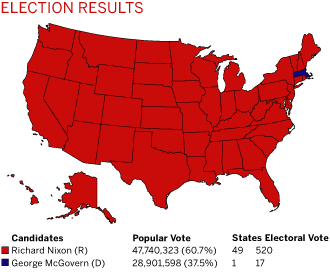
| 1972 | Nixon | McGovern | Results |
In 1971, President Nixon’s approval rating fell below 50 percent. Despite his 1968 promises to end the Vietnam War, the conflict was dragging on. At home, inflation and unemployment were rising. Nixon restored his popularity through several actions: he took unprecedented diplomatic trips to China and Russia; stepped up efforts to end the war by ordering the bombing of Hanoi; instituted wage and price controls; and ended the draft, partly because of the recent lowering of the voting age from 21 to 18. Nixon’s opponent, South Dakota Senator George McGovern, who won his party’s nomination with a grassroots campaign sparked by the antiwar movement, called for withdrawal from Vietnam and a significant reduction in military spending. McGovern named as his running mate Missouri Senator Thomas Eagleton, who, shortly after the convention, revealed that he had been hospitalized for depression and had received shock therapy. McGovern dropped him from the ticket and replaced him with former ambassador R. Sargent Shriver. The incident created an impression of ineptitude. McGovern was also unable to convince the public of any connection between the Nixon administration and the June break-in at the Democratic National Committee headquarters in the Watergate apartment complex.
Spiro Agnew for vice president
"President Nixon. Now More Than Ever"
No incumbent president has used television advertising more effectively than Richard Nixon in 1972. His ad campaign was a two-pronged attack depicting Nixon as a successful world leader and McGovern as a reckless liberal. Nixon’s positive ads used documentary techniques to give voters a glimpse inside the White House, with scenes of Nixon at state dinners, in meetings with world leaders, and at work in the Oval Office. The documentary style gave the spots a feeling of intimacy and authenticity, and created the impression that voters were getting a privileged view. The ads also attempted to humanize Nixon, who was widely perceived as cold and humorless, by showing him in relaxed moments playing the piano for Duke Ellington, dancing with his daughter at her wedding, and joking with Chinese translators.
Nixon’s most effective commercials, however, were attack ads. One spot ridiculed McGovern’s proposed defense cuts by using the stark image of a hand sweeping away toy soldiers, planes, and warships. Another claimed that McGovern would put 47 percent of the country on welfare. Though created by the Republican campaign, these ads were credited to "Democrats for Nixon," a strategy meant to create the impression that McGovern’s liberal views put him outside the mainstream of his own party.
Nixon’s ads were produced by the November Group, a virtual all-star team of advertising executives headed by Peter Dailey, who ran his own Los Angeles agency, Phil Joanou from Doyle Dane Bernbach, William Taylor from Ogilvy and Mather, and an advisory board of executives from many top agencies.
Sargent Shriver for vice president
"McGovern. Democrat. For the People"
The style of McGovern’s ads reflected the populist nature of his campaign. The candidate was filmed in informal encounters with voters in factories, meeting halls, hospitals, and senior-citizen centers. The spots were produced by Charles Guggenheim, the documentary filmmaker who had made many of Adlai Stevenson’s ads in 1956. In his commercials for McGovern, Guggenheim used cinéma vérité techniques. Photographed with a handheld camera and portable sound equipment, the ads were designed to look casual and spontaneous in deliberate contrast with the stately aura surrounding Nixon’s presidency. The ads succeeded in portraying McGovern as compassionate, but they did not make him look presidential.
McGovern had wanted to avoid negative ads, but he changed his mind late in the campaign in reaction to his poor standing in the polls. The attack ads against Nixon were delivered with a "crawl" of white text against a black background. This stark presentation of claims in a seemingly neutral style is now a common technique in political and product advertising.